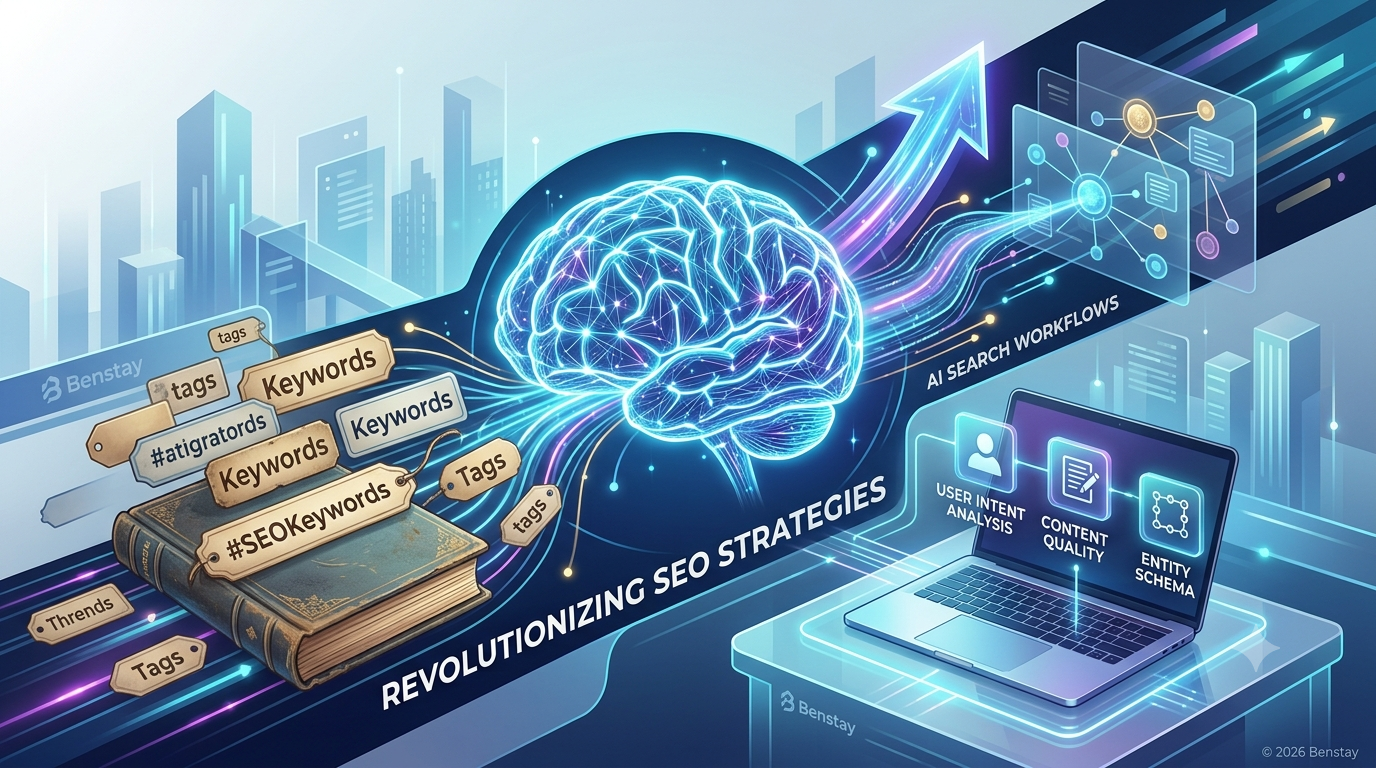
The digital search landscape is experiencing its most profound transformation since the inception of the search engine. In 2026, search algorithms have shifted from merely indexing web pages to synthesizing knowledge. With the integration of Large Language Models (LLMs) into search engines, AI workflows are revolutionizing SEO strategies—forcing businesses to transition from traditional keyword targeting to Answer Engine Optimization (AEO) and Generative Engine Optimization (GEO).
Visibility is no longer determined solely by securing a position among the “ten blue links.” Instead, organic success hinges on whether a brand is recognized as a credible entity and cited directly within AI-generated responses. Understanding and integrating AI search workflows into your marketing infrastructure is now a critical requirement for sustained digital growth.
Table of Contents
1. The Shift: From Indexing Links to Synthesizing Answers
Historically, search engines processed content through a linear pipeline: crawl, index, and rank. Today, AI-powered platforms extract facts, evaluate credibility, and synthesize conversational answers in real time. This requires an entirely different approach to content creation. LLMs do not rank pages in isolation; they pull structured data from trusted sources to assemble a cohesive response for the user.
AI workflows analyze search patterns to determine search intent—informational, transactional, or navigational—with hyper-precision. By utilizing natural language processing (NLP), search algorithms now understand the nuanced context behind complex, conversational queries, eliminating the effectiveness of outdated practices like keyword stuffing.
2. Understanding AEO and GEO
To adapt to AI-driven workflows, marketers must master two primary disciplines:
- Answer Engine Optimization (AEO): The practice of structuring page content so that AI engines (such as Google AI Overviews or voice assistants) can easily extract and cite it. This involves utilizing question-led subheadings, fact-dense summaries, and meticulous schema markup.
- Generative Engine Optimization (GEO): A broader strategy focused on building topical authority and entity recognition across the open web. GEO ensures that generative AI models (like ChatGPT, Claude, and Perplexity) view a brand as a credible, primary source of truth.
3. Traditional SEO vs. AI-Driven SEO Workflows
The mechanics of organic visibility have fundamentally changed. Below is a breakdown of how strategic workflows have evolved:
| Strategic Element | Traditional SEO | AI-Driven Optimization (2026) |
|---|---|---|
| Primary Goal | Rank highest in the list of blue links. | Be cited and accurately represented in AI-generated answers. |
| Content Focus | Keyword density and broad long-form text. | Extractable facts, structured clarity, and contextual completeness. |
| Data Analysis | Manual keyword and competitor research. | Automated search intent prediction and real-time semantic clustering. |
| Off-Site Weight | Volume of inbound backlinks. | Co-citations, digital PR, and forum/community presence (e.g., Reddit). |
4. Actionable AI Optimization Strategies for 2026
Implement Semantic Content Architecture
AI systems require clear formatting to parse information effectively. Organize content using a logical heading hierarchy (H1, H2, H3). Frame key sections as direct questions and provide concise, atomic answers (40-60 words) immediately following the heading. Use lists, tables, and structured data to make factual extraction effortless for the models.
Prioritize Original Data and Experience (E-E-A-T)
As AI generates endless commodities of generic text, search engines prioritize the “Experience” in E-E-A-T. Incorporate proprietary research, firsthand case studies, data visualizations, and original expert insights. Content that adds new data to the ecosystem—rather than summarizing existing web pages—has a significantly higher probability of being cited by AI.
Automate Technical Foundations
A website’s technical health must be flawless to allow AI bots seamless crawling. Utilize AI-powered technical SEO tools to continuously monitor Core Web Vitals, identify broken architecture, and ensure mobile-first rendering. If an AI engine struggles to parse a site’s JavaScript or encounters slow loading times, it will simply pull answers from a faster, more accessible competitor.
5. Measuring Success in the Generative Era
Relying strictly on organic traffic volume and keyword rankings provides an incomplete picture of SEO performance in 2026. Businesses must pivot to new analytics frameworks:
- Citation Frequency: Tracking how often the brand is referenced as a source within AI Overviews and chat-based generative engines.
- Share of Model: Measuring the brand’s visibility and sentiment when an LLM is prompted about specific industry categories or product alternatives.
- AI Referral Traffic: Analyzing the quality and conversion rate of traffic originating from direct links within synthesized AI answers.
6. Conclusion & Next Steps
AI search workflows have permanently altered the mechanics of SEO. Optimizing for generative engines is no longer a futuristic concept; it is the current standard. By focusing on structural clarity, authoritative entity building, and verifiable expertise, organizations can ensure their content remains the definitive source of truth for both search algorithms and human users.
Future-Proof Your Digital Strategy
Transitioning from traditional SEO to AI-driven visibility requires deep technical expertise. At our Jawahar Park office in New Delhi, Benstay delivers custom web development and advanced digital marketing strategies designed to dominate the generative search landscape.
Partner With Benstay Today