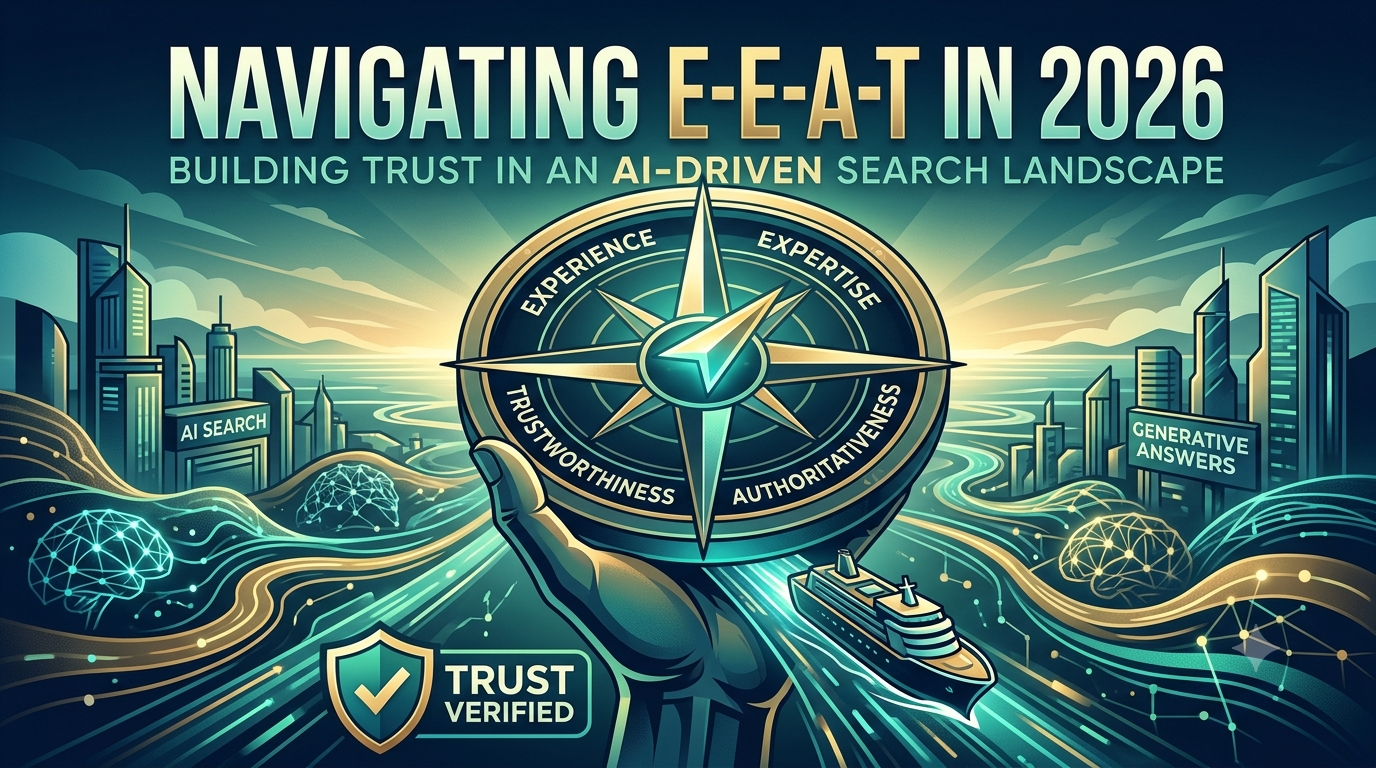
As search engines transition from traditional link-retrieval systems to generative answer engines, search engine optimization in 2026 is no longer defined merely by keywords or backlinks. In an era dominated by AI-generated content, synthetic media, and real-time answer engines, E-E-A-T (Experience, Expertise, Authoritativeness, and Trustworthiness) has evolved into the definitive foundational pillar of organic visibility, brand reputation, and user conversion.
For businesses operating in today’s digital landscape, optimizing for search requires navigating a fundamental shift: search algorithms and consumers alike demand undisputed proof of real-world human experience and verified authority. This guide provides a strategic, actionable blueprint for mastering E-E-A-T in 2026 to safeguard search rankings, cultivate customer trust, and drive sustainable growth.
Executive Summary & Table of Contents
- 1. The Root Cause: Why E-E-A-T Dominates the 2026 Search Landscape
- 2. The Customer Experience (CX) Imperative: Trust as a Conversion Metric
- 3. Strategic Importance: Business Survival in Generative Search
- 4. The Actionable E-E-A-T Solution Blueprint for 2026
- 5. 2026 E-E-A-T Technical & Content Audit Checklist
- 6. Conclusion & Strategic Next Steps
1. The Root Cause: Why E-E-A-T Dominates the 2026 Search Landscape
To understand how to build digital authority today, one must examine the factors that pushed search engines like Google, Bing, and AI search platforms toward strict E-E-A-T enforcement.
The Proliferation of Generative AI Content
The democratization of AI text and media generators led to an exponential influx of auto-generated content across the web. Millions of blog posts, product reviews, and informational pages are generated daily at zero marginal cost. Consequently, web search became flooded with rehashed, generic, and unverified information. Search engines responded by recalibrating their quality algorithms to penalize superficial content and reward verifiable source origin.
The Shift to Generative Answer Engines & Real-Time Entity Resolution
Search engines no longer function merely as indexers; they act as synthesis platforms. When an AI answer engine synthesizes a direct response for a user query, it evaluates the underlying source data for risk, bias, and accuracy. If an entity (author, business, or publication) lacks a clear Knowledge Graph footprint or strong E-E-A-T signals, AI models omit that source to avoid hallucinated or inaccurate outputs.
Algorithmic Shift: The Double “E” (First-Hand Experience)
While Expertise, Authoritativeness, and Trustworthiness have long been guidelines, the addition of Experience has become the critical filter. Algorithms now actively scan for signals demonstrating that content was created by someone with direct, physical, or operational involvement in the topic—such as proprietary photos, original case data, specific client outcomes, and nuanced context that generic AI models cannot replicate.
2. The Customer Experience (CX) Imperative: Trust as a Conversion Metric
E-E-A-T is often viewed strictly as an technical SEO metric, but its primary function is serving the Customer Experience (CX). Modern digital consumers possess high awareness regarding AI-generated media and automated marketing. They seek authenticity before making purchasing or consulting decisions.
In 2026, user experience is fundamentally rooted in confidence. If a visitor detects ambiguity, missing author credentials, or generic claims, friction rises instantly, leading to immediate drop-offs. High E-E-A-T directly reduces bounce rates and elevates conversion velocity.
How E-E-A-T Enhances the Digital Customer Journey
- Eliminating Buyer Skepticism: Displaying verified case studies, real customer success stories, and accredited professional credentials reassures prospects at the consideration stage.
- Frictionless Decision-Making: Transparent pricing structures, clear refund/service terms, and accessible contact details provide psychological safety to online buyers.
- Humanizing the Brand: Highlighting team expertise, founder leadership, and hands-on domain knowledge transforms a faceless website into a reliable advisory partner.
3. Strategic Importance: Business Survival in Generative Search
Prioritizing E-E-A-T yields distinct operational and commercial advantages across organic acquisition, brand equity, and customer retention:
| Pillar | Traditional SEO Focus | 2026 E-E-A-T Focus | Business Impact |
|---|---|---|---|
| Experience | Keyword placement in copy | Original research, custom visuals, case evidence | Higher engagement & time-on-page |
| Expertise | Generic blog content | SME (Subject Matter Expert) reviews & schema profiles | Inclusion in AI Answer Overviews |
| Authoritativeness | Volume backlinking | Co-citations, brand mentions, industry awards | Domain resilience during Core Updates |
| Trustworthiness | Basic HTTPS certificate | Transparent policies, verified reviews, security standards | Increased conversion rate & customer LTV |
4. The Actionable E-E-A-T Solution Blueprint for 2026
Building a robust E-E-A-T infrastructure requires systematically addressing all four elements of the framework. Below is the technical and operational blueprint:
Step 1: Embed Real-World “Experience” Signals
Generative AI can explain theoretical concepts, but it cannot experience real-world scenarios. To distinguish your content:
- Incorporate Original Visual Proof: Use custom photography, video demonstrations, interface screenshots, and proprietary data charts instead of stock photography.
- Share Case Studies & Breakdown Lessons: Include specific numbers, hurdles faced, strategic pivots, and actual project outcomes.
- Publish First-Person Narratives: Detail project workflows using real observations (“When executing this deployment, our team encountered…”).
Step 2: Formalize “Expertise” Infrastructure
Expertise must be explicitly structured so that search engine crawlers and AI agents can verify author credentials.
- Implement Advanced Schema Markup: Use
Person,Organization, andProfilePageSchema to explicitly define author qualifications, certifications, and affiliations. - Establish Dedicated Author Pages: Every article should link to a comprehensive author bio highlighting degree credentials, industry experience, social profiles (LinkedIn), and published works.
- Utilize Peer & Technical Review Workflows: For YMYL (Your Money Your Life) or complex subjects (Legal, Financial, Technical, Healthcare), include a visible “Fact Checked / Reviewed By” line linked to an expert’s profile.
Step 3: Establish Digital “Authoritativeness”
Authority is determined by what others in your ecosystem say about your brand.
- Digital PR & Co-Citations: Earn editorial mentions, podcast features, and quotes in recognized industry publications rather than relying on low-quality guest links.
- Brand Entity Alignment: Ensure your business is registered across major entity databases (Google Business Profile, Wikidata, Crunchbase, official industry directories).
- Publish Original Research & Data Reports: Conduct surveys or analyze internal anonymized data to produce industry benchmark reports that others naturally reference and cite.
Step 4: Maximize “Trustworthiness” Across the Platform
Trust represents the structural foundation supporting the entire E-E-A-T framework.
- Complete Operational Transparency: Clearly display physical office addresses, direct contact numbers, official email addresses, and team bios.
- Robust Site Security & Technical Performance: Maintain top-tier HTTPS security protocols, clean code standards, fast Core Web Vitals, and compliant privacy policies (GDPR/CCPA/DPDP).
- Active Reputation Management: Monitor third-party review platforms (Google Reviews, Trustpilot, Clutch). Respond constructively to feedback and resolve customer issues publicly.
5. 2026 E-E-A-T Technical & Content Audit Checklist
Use this actionable checklist to audit your website’s E-E-A-T compliance:
✓ On-Page & Content Checklist
- Are author bios present on every informational and technical article?
- Does the content include first-hand visuals, proprietary data, or original commentary?
- Are external references linked to reputable, high-authority primary sources?
- Is there a visible “Last Updated” timestamp indicating regular content maintenance?
✓ Technical & Schema Checklist
- Is
Article,Author, andOrganizationJSON-LD Schema properly implemented? - Is the site fully secure with valid SSL certificates and clean payment security badges?
- Are core business pages (About Us, Contact Us, Privacy Policy, Terms of Service) easily accessible from the main navigation or footer?
- Is the physical business location validated via Google Knowledge Graph / GBP?
6. Conclusion & Strategic Outlook
In 2026, building digital trust is no longer a temporary tactic—it is a core business strategy. As AI models continue to shape how information is summarized and delivered, brands that showcase genuine human experience, structured domain expertise, authoritative brand presence, and total operational transparency will thrive in search rankings and generative search platforms alike.
By transforming your content strategy from generic output to authentic, value-driven authority, you secure long-term protection against search algorithm fluctuations while building lasting relationships with your target audience.
Ready to Elevate Your Search Authority & Digital Growth?
Whether you need custom software architecture, digital marketing strategy, or advanced technical SEO optimization, our team helps businesses scale with confidence.
Book a Free Consultation