2026 E-commerce Web Design Trends: What Modern Shoppers Demand
Published on August 13, 2026 | Category: E-Commerce Development & Web Design
Table of Contents
- 1. Introduction: The 2026 E-Commerce Landscape
- 2. The Causes: What is Driving the 2026 Web Design Shift?
- 3. Why Adapting Your E-Commerce Design is Critical
- 4. Reimagining Customer Experience (CX)
- 5. Top E-Commerce Web Design Trends for 2026
- 6. Traditional vs. 2026 Modern E-Commerce UI/UX
- 7. Step-by-Step Implementation Strategy
- 8. Frequently Asked Questions (FAQs)
- 9. Conclusion & Final Takeaway
1. Introduction: The 2026 E-Commerce Landscape
The global e-commerce landscape in 2026 is radically different from what it was just a few years ago. Digital commerce is no longer merely about listing products online, adding a digital shopping cart, and running standard promotional campaigns. Modern digital consumers demand speed, intelligent hyper-personalization, seamless interactive experiences, and complete transparency.
With advancements in Generative AI, spatial computing, micro-animations, and instant zero-friction payment ecosystems, the modern buyer expects storefronts to adapt to their unique behavioral context in real time. Static product grids, sluggish checkout pages, and cookie-cutter layouts are actively driving bounce rates higher than ever before.
To capture market share and maximize Customer Lifetime Value (CLV) in 2026, online retailers must rethink their web design architecture from the ground up—placing human-centric user experience (UX) and advanced technology at the core of their storefronts.
2. The Causes: What is Driving the 2026 Web Design Shift?
Understanding why design standards are evolving is key to creating a sustainable web strategy. Several fundamental shifts in technology and consumer psychology have forced this evolution:
A. The Rise of AI-Driven Search & Discovery
Search engines and discovery engines have shifted entirely toward AI generative answers and intent-driven parsing. Consumers no longer search using simple two-word keywords; they input complex, multi-layered queries. E-commerce websites must display visually clear, entity-mapped structured data and modular design interfaces that dynamic search engines can instantly parse and showcase.
B. Gen Z and Gen Alpha Consumer Dominance
By 2026, Gen Z and Gen Alpha represent a massive share of total global consumer spending power. Raised in an era of ultra-fast video feeds, immersive mobile apps, and instant interactions, these shoppers hold zero tolerance for slow loading speeds, complex form fields, or non-intuitive navigation menu structures.
C. Multi-Device and Spatial Computing Proliferation
Shoppers no longer browse exclusively on traditional desktop monitors or smartphones. The adoption of wearable tech, smart displays, foldable devices, and spatial computing headsets requires websites to utilize fully fluid, multi-viewport responsive design systems that adjust dynamically without losing UI fidelity.
D. Privacy Regulations and First-Party Data Reliance
With third-party tracking cookies fully phased out, brands can no longer rely on external advertising platforms to personalize experiences. Web design must now actively encourage voluntary zero-party and first-party data sharing by offering immediate value through interactive quizzes, personalized visual style builders, and account incentives.
3. Why Adapting Your E-Commerce Design is Critical for Survival
Failing to update your e-commerce storefront in 2026 leads to severe revenue loss and diminishing brand equity. Here is why prioritizing modern web design is essential:
- Drastic Conversion Rate Improvements: Modern UX frameworks remove cognitive friction at every stage of the buyer journey, directly turning casual traffic into paying customers.
- Maximizing E-E-A-T & Trust Signals: Search algorithms and discerning buyers assess website credibility within milliseconds. Clean UI, transparent security indicators, micro-interactions, and instant accessibility signals validate brand authority.
- Drastic Reduction in Cart Abandonment: Complex checkout flows remain the primary reason for abandoned carts. Implementing modern single-tap, biometric, and contextual cart drawers eliminates abandoned transactions.
- Lower Customer Acquisition Costs (CAC): High-converting, visually appealing websites retain users longer, increasing organic brand recall and maximizing return on ad spend (ROAS).
4. Reimagining Customer Experience (CX) in 2026
Customer Experience in 2026 is defined by frictionless immediacy. The modern shopper does not want to search through dozens of pagination links or endure confusing filter hierarchies. They expect an intuitive, bespoke digital experience.
“Modern e-commerce design is no longer about forcing the user through a rigid sales funnel. It is about dynamically molding the user interface around the shopper’s real-time intent.”
Core elements shaping 2026 Customer Experience include:
- Predictive Visual Search: Allowing customers to upload images or drop screenshots directly into the search bar to find matching or complementary products in milliseconds.
- Contextual Micro-Cart Drawers: Shoppers can adjust variants, apply coupons, calculate shipping, and pay directly from a slide-out drawer without leaving the current browsing page.
- Real-Time Dynamic Pricing & Bundling: AI-driven UI modules that present custom product bundles based on active cart contents and browsing history.
5. Top E-Commerce Web Design Trends & Solutions for 2026
1. Dynamic AI-Personalized Layouts & Storefronts
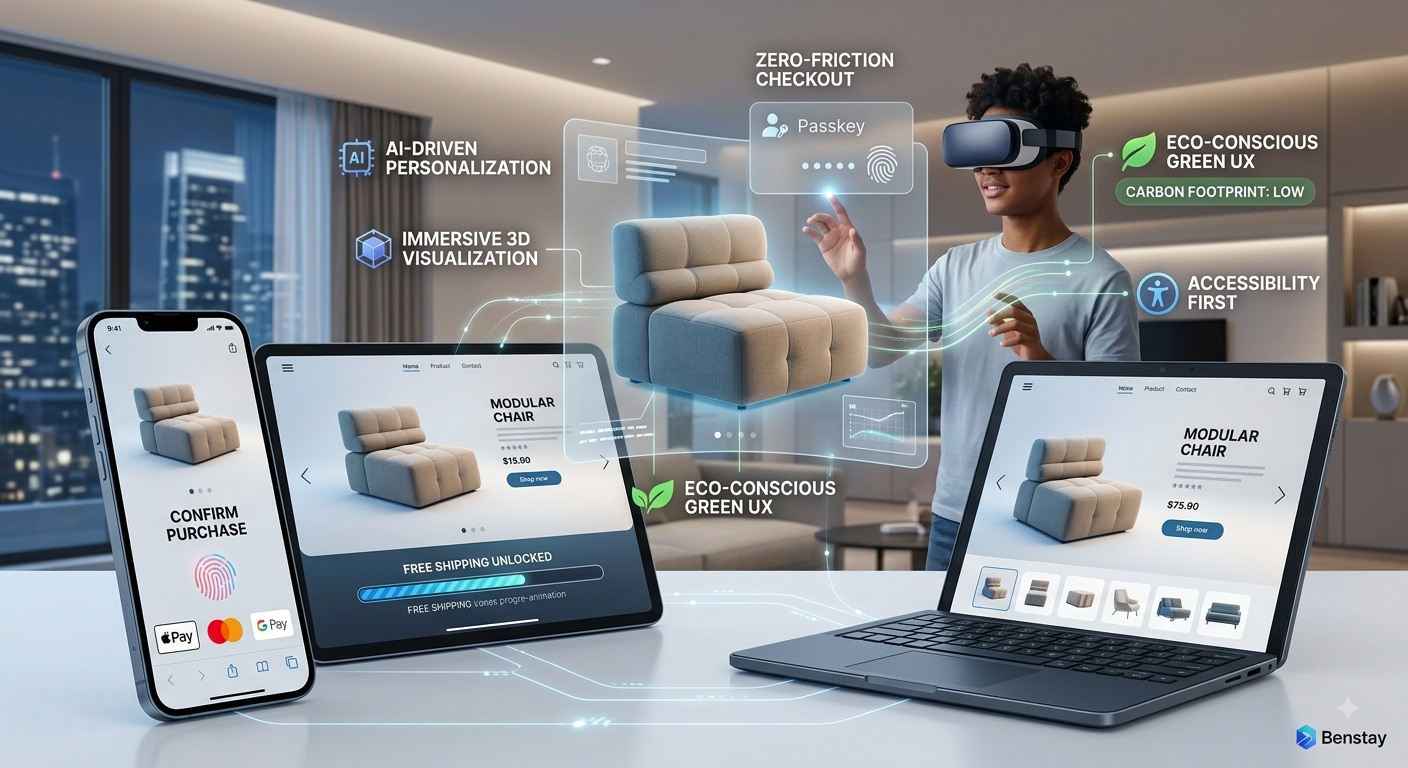
In 2026, one-size-fits-all homepages are obsolete. Modern web design platforms utilize generative layouts that display tailored hero banners, recommended product categories, and dynamic color palettes tailored to the specific user’s location, past purchasing behavior, and traffic referral source.
2. Immersive 3D Product Visualization & Augmented Reality (AR)
Flat 2D images are no longer sufficient for high-consideration purchases like furniture, apparel, eyewear, and electronics. Web design in 2026 incorporates native WebGL, interactive 360-degree 3D models, and integrated AR viewers directly into the product detail pages (PDP), allowing users to visualize products in their physical environment prior to purchase.
3. Micro-Interactions and Kinetic Micro-Animations
Subtle animations guide user attention, confirm user actions, and bring storefronts to life. Subtle hover animations on add-to-cart triggers, progress bars showing free shipping thresholds, and tactile button feedbacks create an engaging, premium feel that keeps shoppers hooked.
4. One-Tap Biometric & Zero-Friction Checkout Systems
Form fields asking for shipping addresses and credit card details manually are relics of the past. 2026 e-commerce checkout design centers around passkeys, Apple Pay, Google Pay, dynamic crypto/digital wallet integrations, and one-tap biometric verification, completing transactions in under 5 seconds.
5. Eco-Conscious & Sustainable Web Design (Green UX)
Modern consumers care deeply about carbon footprints. Sustainable web design reduces page weight, optimizes server queries, compresses media efficiently, and uses dark mode defaults or low-energy color schemes. Adding a transparent carbon footprint indicator on checkout pages reinforces brand sustainability values.
6. Accessibility First (WCAG 2.2 Compliance)
Accessibility is both a legal standard and an ethical necessity. 2026 web design demands high contrast modes, screen-reader friendly DOM hierarchies, scalable typography, keyboard-only navigation, and motion-reduction options for neurodivergent and visually impaired users.
6. Traditional vs. 2026 Modern E-Commerce UI/UX
To help visualize these shifts, here is a breakdown comparing traditional store design approaches against 2026 standards:
| Feature / Metric | Traditional Web Design (Legacy) | 2026 Modern E-Commerce Web Design |
|---|---|---|
| Homepage Layout | Static banner, fixed grid category display | Dynamic, AI-personalized layout tailored to visitor intent |
| Product Media | Static 2D images and plain gallery thumbnails | Interactive 3D models, native AR visualization, video shorts |
| Navigation & Search | Rigid menu trees, keyword match search | Predictive visual search, natural language processing (NLP) |
| Checkout Experience | Multi-step form filling, manual billing entries | 1-Tap biometric payment, sticky slide-out micro-cart drawers |
| Page Speed & UX | Heavy assets, slow DOM rendering (> 3 seconds) | Edge-rendered, sub-second loading, micro-interaction feedback |
7. Step-by-Step Implementation Strategy for Brands
Upgrading your WordPress/WooCommerce or Custom E-Commerce store to meet 2026 standards requires a systematic approach:
- Perform a UX & Core Web Vitals Audit: Measure page render speeds, DOM depth, mobile responsiveness, and current funnel drop-off points.
- Adopt a Headless or Fast Modular Architecture: Utilize modern WordPress block frameworks, decoupled frontend layers, or light page-building tools to guarantee instant loading speeds.
- Simplify Navigation and Information Architecture: Eliminate deep menu hierarchies. Implement sticky search bars with instant predictive autocomplete.
- Integrate 3D & AR Assets on Key PDPs: Start by converting high-margin bestsellers into interactive 3D models.
- Streamline Checkout into a Single Drawer: Reduce steps required to purchase. Integrate single-touch mobile wallets as primary payment buttons.
8. Frequently Asked Questions (FAQs)
What is the most crucial e-commerce web design trend for 2026?
The most critical trend is AI-driven hyper-personalization. Modern storefronts are no longer static; they dynamically adapt layouts, product recommendations, and navigation structures based on a user’s real-time behavior and search intent.
How does 3D and AR integration improve e-commerce sales?
3D models and Augmented Reality (AR) bridge the gap between digital and physical shopping. By allowing customers to visualize products (like furniture or apparel) in their actual environment, it heavily reduces purchase hesitation and significantly lowers return rates.
Is page speed still important for e-commerce SEO in 2026?
Yes, it is absolutely essential. With the dominance of Gen Z and Gen Alpha consumers, a sub-second load time is expected. Search engines heavily penalize slow-loading sites, making Core Web Vitals a top priority for ranking and conversion.
What is a zero-friction checkout experience?
A zero-friction checkout removes all unnecessary barriers to purchase. It replaces long forms with contextual slide-out micro-carts, one-tap biometric payments (like Apple Pay or FaceID), and passkeys, allowing users to buy in seconds.
Can WordPress and WooCommerce handle 2026 design trends?
Absolutely. By utilizing headless WordPress architectures, lightweight block themes, edge-rendering, and modern caching solutions, WooCommerce stores can fully execute dynamic AI layouts and lightning-fast zero-friction checkouts.
9. Conclusion & Final Takeaway
The e-commerce industry in 2026 leaves no room for outdated, slow, or generic storefronts. Modern shoppers demand speed, immersion, dynamic personalization, and effortless usability. By adopting 2026 web design trends—such as AI-driven dynamic layouts, 3D/AR product displays, biometric single-tap checkouts, and eco-conscious web design—brands can build trust, boost conversion rates, and build long-term customer loyalty.
If you are ready to modernize your e-commerce storefront, optimize your user experience, and drive measurable growth, adapting your digital design framework today is your single most effective competitive advantage.